A skin check is a visual examination of your skin to look for moles, spots, or lesions that may be harmless or could be signs of skin cancer. In Australia, Medicare covers some skin-related consultations, investigations, and treatments through rebates for eligible services provided by a General Practitioner (GP) or specialist. But there is no dedicated Medicare item specifically for routine preventive whole-body skin cancer screening.
Today we will be talking about your skin check eligibility, exclusions, treatment, costs, bulk billing, what happens at a skin check, warning signs, and where to get checked.
Does Medicare Cover Skin Checks in Australia?
Yes, in Australia, Medicare covers skin checks, but the Medicare Benefits Schedule (MBS) does not contain a specific line item or code for “skin check.”
Patients can go for a full-body skin assessment that is billed by doctors using standard, time-based Professional Attendance (GP consultation) items. The most commonly Item are 23 (Level B, lasting up to 20 minutes) or Item 36 (Level C, lasting at least 20 minutes).
What Medicare does cover is the underlying medical service:
- A GP consultation becomes Medicare-rebatable when the doctor is assessing a genuine clinical concern like a changing mole, an unusual spot, or a lesion that won't heal.
- The rebate applies to the consultation itself (under standard MBS attendance items), not to a marketing label a clinic might use.
- Having a Medicare rebate doesn't automatically mean the appointment is free. That depends on whether the clinic bulk bills.
When Can Medicare Cover a Skin Check?
Since Medicare does not have a dedicated skin check, it tracks the actual reason for your visit. If your concern is about assessing, diagnosing, or treating a specific issue, it can fall under a rebate rather than a general, no-symptoms screening appointment.
1. You Have a Suspicious Mole or Skin Lesion
Seeing a GP about a specific worry can form part of an eligible consultation. Medicare assumes such case eligible for the consultation and the doctor’s clinical assessment. You can not simply go for a “mole check” on a booking page.
Common reasons people book include:
- A new or unusual spot that wasn't there before.
- A mole that's changed in size, shape, or colour.
- A sore that hasn't healed after a couple of weeks.
- Bleeding, crusting, or persistent itching in one spot.
2. Your GP Needs to Assess a Skin Problem
When a doctor examines a lesion as part of managing your health, that’s a standard GP attendance. The doctor takes a history, looks at the area, may use a handheld magnifier, and decides whether anything needs further investigation.
An eligible consultation like this is billed under standard MBS attendance items. For example, item 23 for a standard visit under 20 minutes, and this carried a Medicare rebate of $45.05 from 1 July 2026. (Australian Government Department of Health). Whether you pay anything extra depends entirely on the clinic’s billing model.
3. Further Testing or Treatment Is Needed
If something looks suspicious, your GP may order testing or treatment, such as:
- A biopsy to sample the tissue.
- Pathology testing on that sample.
- Surgical removal of a lesion.
- A referral to a dermatologist.
Medicare has specific MBS items covering clinically necessary skin procedures. This includes a dedicated set of items (31377–31383) for clinically suspected melanoma, which allow doctors to bill before histology confirms the diagnosis. Excision and biopsy items (broadly 31206–31388) each carry their own histology and documentation requirements.
When Is a Skin Check Not Covered by Medicare?
A routine, preventive screening with no specific concern is generally not covered by Medicare’s rebate structure.
Screening: A routine skin check that looks for skin cancer when you have no specific symptoms or concerning spots. Medicare does not have a dedicated MBS item for routine preventive skin cancer screening.
Diagnosis or management: A doctor assesses a specific mole, lesion, symptom, or skin concern to diagnose or manage a medical issue. The consultation or related service may attract a Medicare rebate if it meets the relevant MBS requirements.
If a general check turns up something worth investigating, the service performed on the day determines what’s billed. The best is you can ask the practice directly whether your specific appointment will attract a rebate before you book.
Does Medicare Cover the Cost of Skin Cancer Treatment?
Medicare can subsidise many eligible services for diagnosing and treating skin cancer through the Medicare Benefits Schedule (MBS). The costing covers GP and specialist consultations, Public hospital treatment, biopsies, pathology, and eligible lesion removals. The exact rebate depends entirely on which MBS item applies to the service provided.
Note: Medicare rarely covers 100% of a provider’s fee. Private providers can charge above the scheduled fee, and hospital or specialist billing can work differently to a standard GP visit. You can look up estimated fees and government contributions for specific procedures using the Australian Government Medical Costs Finder.
Is a Skin Check Free With Medicare?
Not automatically, because a Medicare rebate and a free appointment are two different things. This is one of the most misunderstood parts
- Bulk billing: The provider accepts the Medicare benefit as full payment, so you pay nothing at the time of the visit.
- Private billing: The provider charges their own fee, you pay upfront, and Medicare reimburses part of it.
Nationally, around 84.1% of GP visits were bulk billed in the June 2026 quarter, though rates vary sharply by state. Where a visit wasn’t bulk billed, patients paid an average of roughly $60 out of pocket in the same period. A single clinic can also bulk bill a standard consult while charging privately for dermoscopy or photography.
How Much Does a Skin Check Cost in Australia?
There’s no single nationwide price for a skin check in Australia, but a rough estimate can be typically costs between $110 and $240 before a Medicare rebate. This means you may need to pay around $60 to $100 for a standard or full-body check. The costing also depends on practices set their own fees and billing arrangements.
Average Costs and Rebates
- GP clinic, standard skin check: Roughly $70–$120 before any rebate.
- Dedicated skin cancer clinic: Roughly $105–$230, depending on appointment length.
- Full-body check with mole mapping or photography: Often $200–$400+, since this add-on usually isn't Medicare-rebated at all.
- Dermatologist: Higher, with larger gap fees, and usually needs a referral for any rebate to apply.
Cost depends on:
- The length and depth of the appointment.
- Whether the clinic bulk bills that particular service.
- Whether dermoscopy, photography, or mole mapping are billed separately.
- Whether a biopsy or removal is needed on the day.
Ask the practice for the total fee, the expected Medicare rebate, and the likely gap before you book; prices and billing policies do change.
What Happens During a Skin Check? What to Expect Step-by-Step
When you visit for a skin check, be prepared, as you need to start by changing into a gown, have a discussion with the GP, have a full-body check-up, and the specialist may use dermoscopy too.
The exact process varies by practitioner, but most follow a similar pattern:
- Preparation: You'll usually change into a gown, generally keeping your underwear on.
- Discussion: The doctor asks about your medical and family history, sun exposure, and anything specific you've noticed.
- Head-to-toe examination: It includes areas people often forget, like the scalp, behind the ears, between fingers and toes, and the soles of the feet.
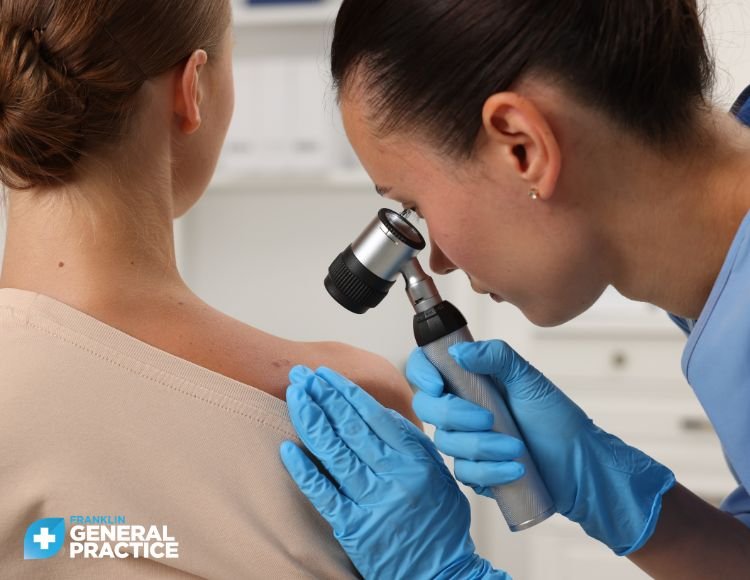
- Dermoscopy: A lighted, magnifying tool called a dermatoscope lets the doctor examine specific spots more closely.
- Biopsy, if needed: A suspicious spot may be numbed and a small tissue sample taken for lab testing.
When Should You See a GP About a Skin Spot?
If the skin spot is new, changing, or shows signs of potential concern, it’s time to visit a GP.
- New spots: Any mole or lesion that appears for the first time in adulthood.
- Changing moles: A shift in size, shape, height, or colour.
- ABCDE signs: Asymmetry, an irregular Border, uneven Colour, a Diameter over 6mm, or Evolution over time. This is a useful awareness tool, though not every skin cancer follows it neatly.
- Troublesome symptoms: Persistent itching, tenderness, inflammation, bleeding, or crusting.
- Non-healing sores: A scaly patch or sore that hasn't healed within two weeks.
- The "ugly duckling" rule: A spot that simply looks different from your other moles.
How to Get a Skin Check in Australia
Our Franklin doctors check moles and spots, answer your Medicare questions, and refer you to a dermatologist if needed.
You can either visit a GP directly or a dermatologist for a skin check and skin cancer check. There are also skin cancer clinics people go to for checkups. But remember Medicare’s role differs across each one.
General Practitioner (GP): The most practical first stop. Many GPs assess moles and lesions as part of standard care, and some clinics bulk-bill eligible consultations. You can search local options through Healthdirect’s service finder.
Dedicated skin cancer clinics: Chains and independents such as MoleMap, SunDoctors, and Australian Skin Cancer Clinics focus specifically on skin health. No referral is needed, but expect private fees for most of the visit, particularly photography or mole mapping.
Dermatologists: Specialists for more complex or suspicious lesions. A GP referral is usually needed for a Medicare specialist rebate to apply, and gap fees are common.
For the exact rules around billing and item numbers, Services Australia’s MBS billing guidance sets out which procedures require histology before they can be claimed.
The Bottom Line
Medicare doesn’t have a specific item for routine preventive skin cancer screening, but eligible consultations, testing, and treatment for an actual concern often attract a rebate. A rebate doesn’t automatically mean a free visit, that comes down to whether your clinic bulk bills.
If you’ve noticed a new, changing, or non-healing spot, don’t wait for cost clarity to get it looked at. Ask the practice about their billing before you book, and bring any specific concerns to your GP directly.
Frequently Asked Questions
Does Medicare pay for skin cancer checks?
There’s no dedicated MBS item for routine preventive screening. Eligible consultations for a specific concern may attract a Medicare benefit.
Are skin checks free with Medicare?
Not automatically. A rebate only means the appointment is free if the clinic bulk bills that particular service.
Does Medicare cover mole checks?
Assessment of a specific suspicious or changing mole can form part of an eligible consultation. Not every standalone “mole check” package is automatically covered.
Does Medicare cover skin cancer diagnosis?
Yes, Medicare can subsidise eligible services used to investigate and diagnose suspected skin cancer, subject to standard MBS requirements.
Does Medicare cover skin biopsy?
Clinically necessary biopsies can attract a Medicare benefit under the relevant MBS item. Out-of-pocket costs still depend on the provider’s billing arrangement.
Can I get a skin check from my GP?
Yes. Many GPs assess suspicious lesions and offer full skin examinations — confirm this is what you want when you book, since not every practice offers a comprehensive check by default.
How much does a skin check cost in Australia?
There’s no standard price. Expect roughly $70–$120 at a GP clinic before any rebate, and $105–$230+ at a dedicated skin cancer clinic.
Does bulk billing cover skin checks?
If the specific service is Medicare-eligible and the provider bulk bills it, there’s generally no gap. Not every clinic bulk bills every part of a skin check appointment.